20110510

Abrasive blasting metal


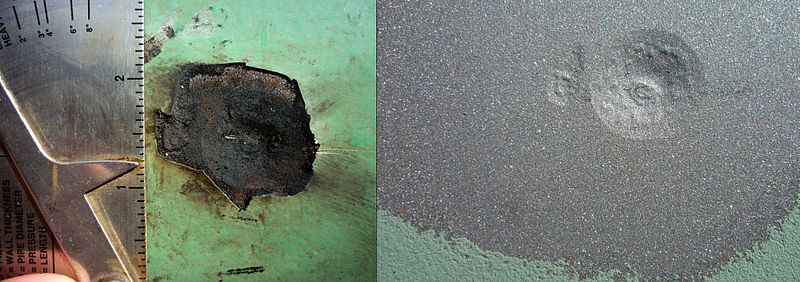
This is very similar to the machine I was using to grit blast my metal. It shoots out grit at a very high speed, at a very high temperature, so it is very important for it to take place in an enclosed area using high strength rubber gloves for protection.


Here is an example of how grit blasting can be very effective for covering up a broken or worn area. This can be relative to my project in the sense that the life of a homeless person is covered up by the stereotype and perception many people already have of them. 

Making the shell of my book

I went into the workshop last week to create the steel shell i have planned to use for the shell of my book. I was in good hands under the supervision of the tutors in the workshop so I was shown how to use the tools necessary. A lot of the work involved trimming metal and filing edges to ensure there were not sharp edges. The complicated part was deciding what finish I would use for the metal. I was shown various sanding techniques as well as a technique called grit blasting.

Grit blasting was the technique I went with after a long time considering. I chose this technique due to the matte and rough effect it gives to the metal. I felt this was a relative technique to combine with my case study. It is also a technique used for when you want a bad piece of metal to look better so you cover it with grit and it masks any imperfections. After having been told this, I felt it was a perfect compliment to my book.

It came out pretty much as I would have liked it to, but there have been some marks made on it for whatever reason, but with my case study being the homeless and vulnerable, I did not mind the fact that the finish was not perfect. There are some spots on it that look scratched or look like fingermarks but after stepping back and looking at it again, I began to become keen of the imperfections.

This weekend I went to an engravers to talk through what I wanted done and it is currently getting engraved. I was told it will be posted to me when it is finished so I can only wait and hope it has come out as expected.

20110427

Front Cover of Book


So the front cover of my book is going to be metallic, as well as the spine and back of the book. I am getting the  text engraved to add a sense of importance to the product. It will be a tough cover for what is just a book but the connotations carry a lot more meaning. The metallic element makes the pages seem encased, thus giving the reader a real sense of revealing stories that are not necessarily meant to be read.

The first page of the book will also have the design of the front cover in black and white, as many books do in the commercial market.

20110426

Pagination of Final Book

I am making a B.L.A.D as a final outcome for my project. Here is the breakdown of the pages:

  • 8 Profiles. Each profile will use 3 pages.  8 x 3 = 24
  • Contents page x 1
  • Introduction x 1
  • Focus on the Volunteers x 4
  • Thankyou page x 1
  • Ralph Millward dedication page x 1
And with 10 blank pages between each profile it would make my book page count 102.

The wieght of the blank pages will be 150gsm, with the pages for the profiles being a mix of 110gsm and 150gsm. With this in mind I can work out the thickness of the book and begin the production of my metal book cover.

The Unequal Homeless


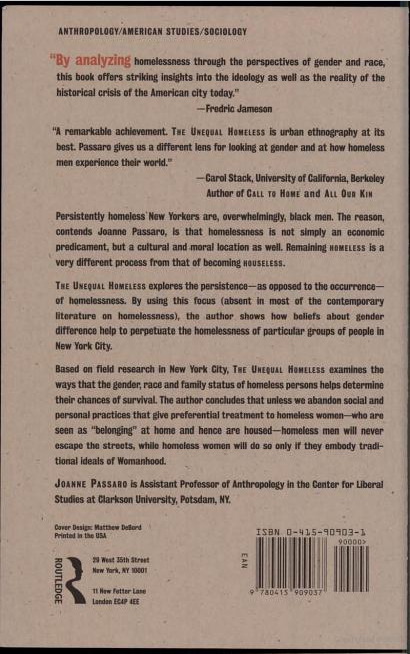
Front and back cover to recent book used for my current case study. Its draws on very interesting points relating to homelessness and gender.

The Unequal Homeless: Men on the Streets, Women in their Place

Book written by Joanne Passaro

"The Unequal Homeless explores the persistence, as opposed to the occurrence, of homelessness. With this focus, which is absent in most of the contemporary homelessness literature, the author shows how cultural expressions of beliefs about gender difference help to perpetuate the homelessness of particular groups of people in New York City.

The people who are persistently homeless in New York are, overwhelmingly, black men. The reason, Passaro contends, is that homelessness is not simply an economic predicament, but a cultural and moral location as well. Remaining homeless is a very different process from that of becoming homeless.

Based on field research in New York City, The Unequal Homeless examines the ways that gender, race and family status of homeless persons help determine their chances of survival. The author concludes that unless we abandon social and personal practices that give preferential treatment to homeless women--who are seen as "belonging" at home and hence are housed--homeless men will never escape the streets while homeless women will do so only if they embody traditional ideals of womanhood."


Reference: http://www.goodreads.com/book/show/1801473.The_Unequal_Homeless

20110425

Gender-specific Correlates of Sex Trade among Homeless and Marginally Housed Individuals in San Francisco

By Sheri D. Weiser, Samantha E. Dilworth, Torsten B. Neilands, Jennifer Cohen, David R. Bangsberg and Elise D. Riley

"Objective: Sex exchange is a well-established risk factor for HIV infection. Little is known about how correlates of sex trade differ by biologic sex and whether length of homelessness is associated with sex trade. We conducted a cross-sectional study among a sample of 1,148 homeless and marginally housed individuals in San Francisco to assess correlates of exchanging sex for money or drugs. Key independent variables included length of homelessness; use of crack, heroin or methamphetamine; HIV status; and sexual orientation. Analyses were restricted by biologic sex. In total, 39% of women and 30% of men reported a lifetime history of sex exchange. Methamphetamine use and greater length of homelessness were positively associated with a history of sex trade among women, while heroin use, recent mental health treatment, and homosexual or bisexual orientation were significantly associated with sex trade for men. Crack use was correlated with sex trade for both genders. Correlates of sex trade differ significantly according to biologic sex, and these differences should be considered in the design of effective HIV prevention programs. Our findings highlight the critical need to develop long-term services to improve housing status for homeless women, mental health services for homeless men, and drug treatment services for homeless adults involved in sex work."

Reference: http://www.springerlink.com/content/j834785043m2kg3p/

A comparison of homeless men and women: Different populations, different needs

By Carol S. North and Elizabeth M. Smith

"Homeless women are very different from homeless men, but few studies have reported data separately on them or compared them directly with men. This report on a study of 600 homeless men and 300 homeless women in St. Louis presents comparison data on these populations. The pivotal difference between homeless men and women was that unlike men, most women had young children in their custody. The women were also younger than men, more likely to be members of a minority group, and more often dependent on welfare. They had been homeless for a shorter period and spent less time in unsheltered locations. Compared to men, they had less frequent histories of substance abuse, incarceration, and felony conviction. Solitary women (without children with them), compared to women with children in their custody, were more likely to be white, had been homeless longer, and more often had a history of alcoholism or schizophrenia. On most variables, values for solitary women lay some-where between those for men and for women with children. The population of homeless women is therefore heterogeneous, with at least two subgroups. These groups are likely to benefit from intervention programs that are designed to address their specific problems and needs, which are not necessarily the same as those of homeless men."


Reference: http://www.springerlink.com/content/w3400u1ru0100v57/

Homeless mentally disordered offenders and violent crimes

By Daniel A. Martell

"This study examines the prevalence of homelessness in a cross-sectional sample of 150 patients retained in a maximum-security hospital for mentally disordered offenders in New York City. The homeless mentally ill comprise only 2% of the city's mentally ill population, yet they account for 50% of the admissions to this forensic facility from the community. Compared to population base rate estimates, forensic patients are homeless at 25 times the rate found in the rest of the city's mentally disordered population and are 50 times more likely to be homeless than the general population. Further, there is a significant association between homelessness at the time of the instant offense and charges for violent crimes, after controlling for age, sex, race, and diagnosis. These data suggest that homelessness greatly increases the risk that mentally disordered persons will be forensically hospitalized and is closely associated with indictments for violent criminal behavior. Alternative explanations for these findings are discussed, emphasizing risk, vulnerability, and criminalization perspectives."


Reference: http://www.springerlink.com/content/mm73u15030l34375/

Perceptions of and reactions to the homeless: A survey of fourth-grade, high school, and college students in a small Midwestern community

By Mark A. Barnett, Steven W. Quackenbush and Lisa K. Pierce


"A total of 459 fourth-graders, high school students, and undergraduates completed a Homelessness Questionnaire developed for use in this study. Although participants generally expressed positive and supportive attitudes toward the homeless, attributing homelessness to either social maladjustment (e.g., drug problem) or negative characteristics (e.g., laziness) within the homeless was positively associated with “fear of and anger toward the homeless” for all groups of participants. In addition, perceptions of and reactions to the homeless were influenced by both the participants’ gender and age group. Although high school and college students’ interest in helping the homeless was associated with various attitudes and reactions (e.g., feelings of sympathylsupport), their indication that they had ever helped homeless people (either directly or indirectly) was consistently associated only with the acknowledgement that their mother and father had ever helped homeless people (either directly or indirectly). Among these older participants, homelessness in the United States was rated as a more serious problem at the end of the questionnaire than at the beginning."


Reference: http://www.springerlink.com/content/p325g70505501808/

Teenage Paparazzo: I AM Hollywood Homeless


An interesting insight into the lives of the homeless community in the celebrity capital of the world.

Page Samples


Sample shots of page examples. First page is printed on Chromatico Digital Clear 150gsm. Second page is printed on Chromatico Digital Clear 110gsm. Third page is printed on Premium White 120gsm.

20110421

Becky Blanton - Life experience as a homeless woman

Very inspiring talk. And a realisation that being homeless is very much a situation that anyone could find themself in.

20110407

Ralph Millward.

Ralph Millward was murdered by three drunk teenagers in May 2009 and was a good friend of many poeple that attend the Westbourne Baptist Church. His Funeral was held where I have been going for the Open Breakfasts and I am extremely fortunate that Tommo and Paul talked to me about the much loved man. The video below is coverage of his funeral, in which hundreds were in attendance.

My project and book will be a fitting dedication towards Ralph.

20110329

WRL - Interview with James Roberts


As part of my work related learning module, today I had an informal interview with designer and ex Visual Communication student, James Roberts. He now works at BeCreative based in Brighton and he is a mid level designer, and the companies services include:

  • Design for Print - Brochures, Leaflets, Stationary
  • Daily National Press Advertising Service
  • Direct Mail Campaigns
  • Corporate Identity
  • Large Format Posters, Banners
  • Points of Sale
  • Websites, Animated Banners
  • Emails, HTML, Newsletters

During my time talking to him, I asked him how he went about this Work Related Learning unit, as I expressed my stress and inability to get a visit from ANY design offices that I had contacted. He said that he too had a hard time getting a placement but eventually managed to find one through 'pesting' companies. Thats how he put it. 'Pesting'. I personally hate this idea. He also said that, like me, he does not enjoy speaking on the telephone. So his jobs came from constant emails to nearly every company in Dorset. I do not want to beg and pest managing directors, as I feel it would become very annoying and the person would just end up not wanting you at all. The way I see it, is the design company are obviously going to be open to hearing people that want to work and will consider you, but the ones that are far too busy wont bother replying. Unfortunately I have had a lot of the latter.

He told me about how he had known people to come up with innovative ways of getting noticed whilst applying for a job. One person he knew had sent the company a toilet brush, with a note saying 'Im willing to scrub the toilets if you're willing to give me a chance. Another one, a personal favourite, was someone sending a photo of himself completely naked (covering up of course), with the strapline 'I need some briefs, can you help me out?'. I might try this one.

I also learnt that it does not hurt to show off other qualities other than design. He said this factor was the reason for him getting his first job. The fact he could speak to the MD in a foreign language was a persuading characteristic that he could use over other candidates, that probably had more experience than him.

James also encouraged me to look in places that you would normally ignore or not even think to look in. He told me about the time he once went into the job centre to see if there were any design related jobs going in there. But he told me that if I ever see anything I like, to take a note of it and not to be scared to email them and ask them about it. 

Student Masterchef


Me and my housemate were bored on sunday afternoon, so after a lazy morning watching Masterchef re-runs, we decided to have a competition to see who could make beans on toast look like a dish on Masterchef. My plate is the top one. 

20110325

3rd Visit to Westbourne breakfast for the homeless


Here are a few images taken from my visit to Westbourne Baptist church's open breakfast this morning. The lady in the top photo is the Murial, she is in charge of the running of the breakfast. She is looked up to by everyone involved in the programme and is very passionate about it, saying that she has 'always supported the underdog'. All the homeless community are very polite towards her and they see her as one of her own. She enjoys giving something back to the community as she used to suffer from alcoholism herself, and says she enjoys helping  and seeing results in the people that she serves.

The guy in the next photo down is Paul. I have spoken about Paul before, and before he was skeptical about having his photo taken as he was unsure as to whether he was going to be kicked back out on the streets. Since then he has now found a flat for him and his dog and was happy to have my camera shoved in front of him.

Then the bottom photo is Tom, Tommo or Tommy. Known by nearly everyone in the area, he is a real character. Him and Paul are good friends and Paul tells me about how he had to help Tom when he had his first heart attack (of 2). It sounds as if he has had some stinking luck, from a guy who used to be sous chef at a well known caterers, and had the opportunity to cook in the Houses of Parliament. Unfortunately however, he says he had to cook for Maggie Thatcher! He is a long time sufferer of alcoholism and says that he has no intention of giving it in.

20110322

Page examples of book


Through my research I am finding that it is very important to choose a considered paper stock and weight for making a book. It should compliment the content of the page and have reasoning for why it is used. This got me thinking about the subject I have chosen and how I could relate this to stock. A lot of the people of the homeless community that I have met no longer have any address, dental records, health records, insurance, driving license etc. Its almost as if they are invisible on paper as they don't exist in document form, only physical. This feature could be utilized by using vellum paper (semi transparent) to act as an indication of their existence. It is about 100gsm in weight and is very similar to tracing paper.

2nd visit to Westbourne church open breakfast.

I was a little more relaxed going into this one. I had got to know the volunteers and a few of the faces that come in to have their breakfast so I felt a little more at ease. I didnt hang around this week and think I felt more confident with a camera in front of me this week.

Adrian
Adrian didn't speak to me much but I was told about him from one of the volunteers. He used to be a Head Master at a school in the Dorset area but a panic attack saw him lose his job and struggle to hold down work ever since due to the side effects he still suffers. He was a very intelligent man who was noticeably well spoken.

John
John became homeless when his wife kicked him out of the house that they had bought together for them and their children. He had been with her, living in Blackpool, for 14 years before they got married. But were only married for 6 months before their separation. It was the drink that was Johns downfall also. I didn't ask too much about it as it is human nature to not want to talk about your darkest times to complete strangers. But I believe he lost his job as he started turning up late and in no state to work. He is originally from Birmingham and grew up in the same area as my Dad funnily enough. He is getting his life back order, as he now has a bedsit that he can fund with jobseekers allowance, and at the time of writing, is getting ready to start a job in 3 weeks time. He says that if his wife ever sells the house he is giving his half to the kids, stating that he'll be "alright".

Simon 'Doormouse'
Simon is originally from South Africa who moved here with his parents when he was younger. He talked about his very short marriage but not much as to how he became homeless. However whilst I was standing with him, one of his friends asked him when his last 'blow out' was. A blow out is a term used by the homeless community that means you have been sober for a while, and then you just forget about reality and slip into your own little world, whatever and wherever that is. He described the feeling being very addictive and if you haven't drunk for a while it doesn't cost you much at all to have a blowout. He also said that there are many 'soupies' in Bournemouth and there is no reason to ever go hungry.